Goodreads Giveaway! Guardian Angel by Anne Rouen

It’s coming up to Anzac Day (25th April), and to honour it, I am offering a Goodreads Giveaway!

For your chance to win 1 of 100 Amazon Kindle copies of Guardian Angel my recently released World War II Historical Fiction drama romance, simply make your free entry here.

Entries are open from April 13 – April 25, 2018 (US Westcoast time). All you need is a Goodreads account and a US Amazon Kindle Account.

Good luck! Enter now!

Goodreads Book Giveaway

Guardian Angel by Anne Rouen

Guardian Angel

by Anne Rouen

Giveaway ends April 25, 2018.

See the giveaway details
at Goodreads.

Enter Giveaway

The More Things Change …

Old Postcard – WWI Era

Another year has just sped by, with its fair share of joy, sadness and inspiration, leaving me little time to catch my breath. It hardly seems possible that, a whole twelve months later, I am wondering exactly the same thing about the year that has just gone. Where? And how quickly!

One hundred years ago, my grandfather was preparing to face the worst year of his life on the Western Front, not believing that he would survive; little knowing that it was to end in an Allied victory.

Now, a century later, with my father approaching his 90th birthday, the world has developed amazingly. Although, some would say, not for the better.

Looking, with misgiving, at the attitudes of our leaders; tensions simmering in odd little corners of the globe, with threats and posturing uncannily similar to those of pre-WWI, I realize there is one constant in our ever-changing world – human nature.

The old adage: The more things change, the more they stay the same, is just as apt now as it ever was.

I might have said that my New Year’s resolution was to have no resolutions, but I do have two. One is to publish Book IV, Guardian Angel, which will complete my Master of Illusion series. And the second is to finish the two novels I have been working on all year. The first will be accomplished very soon. For the second, I am taking inspiration as it comes. (Refer to adage, as above.)

Today, as we stand on the brink of the unknown; a bright, untrammeled new year waiting to be ushered in; I take this opportunity to wish all my readers a safe, happy, exciting and inspirational 2018.

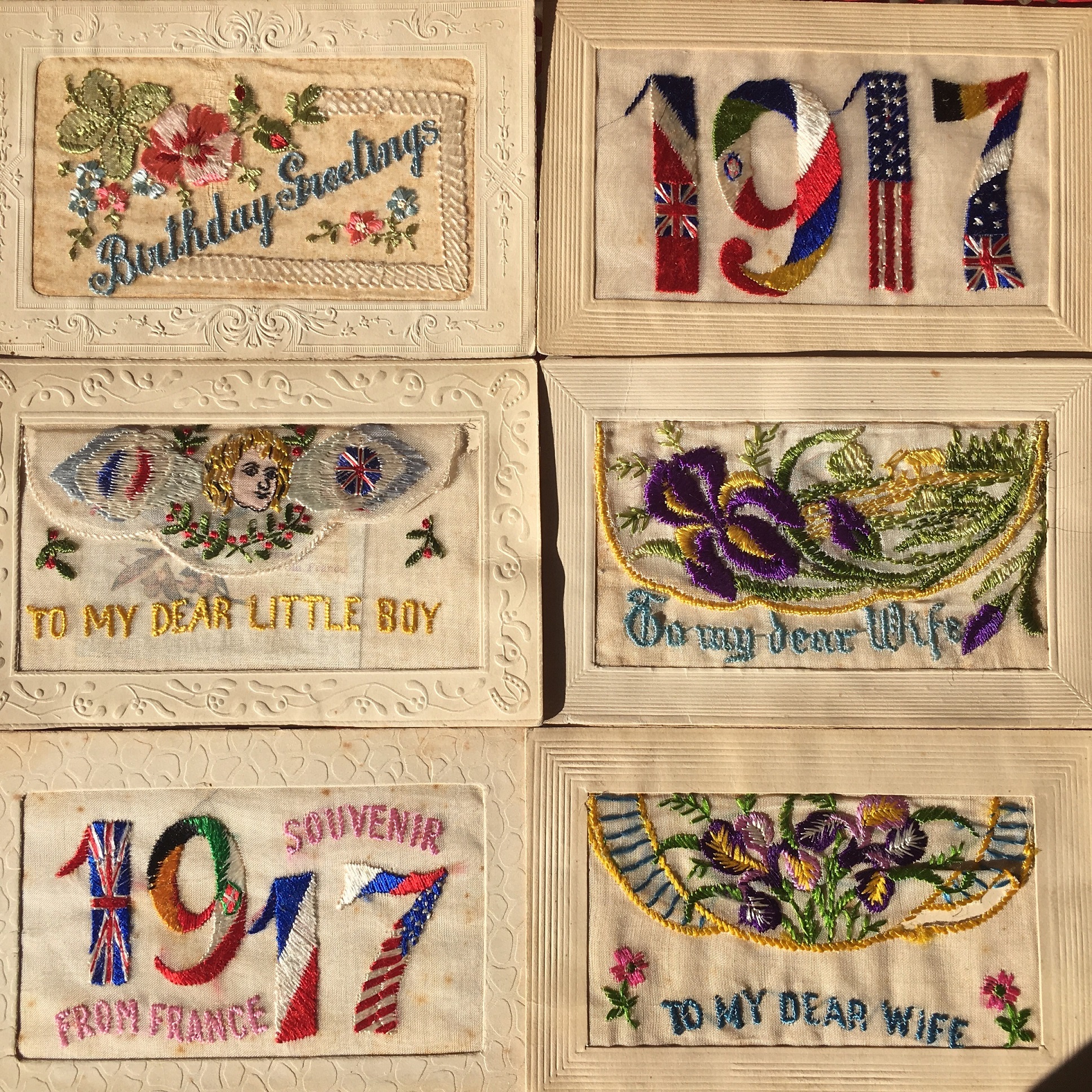
Postcards From the Front

Beautiful embroidered postcards from France – WWI. Photo courtesy Felicity Matthews.

Making lace and silk-embroidered postcards and souvenirs for homesick Australian soldiers became a cottage industry for many Frenchwomen during the long, hard years of World War One.

The examples sent home by my grandfather are exquisite – cards decorated with fine hand-made lace and colourful silk embroidery. Some were in the form of envelopes on the front of the card in which could be placed tiny cards, smaller than today’s business cards, with printed messages such as Merry Christmas; To my dear Wife; To my darling Son; etc.

Other items he sent home were embroidered silk stocking covers; delicate handkerchiefs; silk-painted pillow shams and antimacassars fringed with wide lace borders that gave them an appearance of luxury. One very special cushion cover had a painting of buildings on fire and was entitled, The Burning of Arras. Obviously a commemoration of one of the great tragedies of the war.

The fine hand-made lace, the sheen of the silk and the painting of these artefacts is magnificent and the fact that they are still in existence today, as bright and beautiful as ever, is a testament to both the quality of the materials and the work of these wonderful and talented Frenchwomen of the Great War.

Letter From The Front

Letter from France 1918 with original envelope.  Photo credit: thanks to Felicity Matthews.

Whilst going through some old family papers and photographs I stumbled upon a small wooden box and in it found a real treasure: a letter, dated July 6th 1918, from my grandfather in France to my grandmother in Australia. It was dog-eared, the ink faded and the paper thin and fragile after ninety-nine years and obviously many readings. So I decided to transcribe it, eager for insight into the mind of a man writing from his camp on the Western Front, after years in a war zone, separated by time and distance from his loved ones. And as I worked, it was as if his voice reached out over almost a century and spoke to me.

I found it very sad because it is obvious that at this point in the war, my grandfather believed that one of his brothers had been killed and that he himself would most likely not survive to come home. He was not in a very positive state of mind and also felt the need to go into battle and avenge his brother’s death.

It is interesting to note that this was at the height of the escalation of World War I because the Germans had come back from the Eastern Front after the surrender of Russia and were concentrating their might against the Allies on the Western Front. No wonder he felt that it was never going to end!

I also found it a point of interest that the United States Army clearly looked after their men a lot better than did the British. So, good on you, Uncle Sam!

Here is the letter, faithfully transcribed, except for a few personal items that can have no meaning for anybody but the writer and recipient:

France

July 6th 1918

Dear Violet,

Just a short note in answer to your three letters I received yesterday and the snapshots of Ernie (21/2 year old son).

They are very nice. He does look well in those photos. He ought to be good company for you. I wish I was back. I would take him everywhere. You say he is a hard case and my word he looks it.

It was a great day here on the fourth of this month. The Bakers that were here, the Yanks I mean, did not work at all that day. No matter what Holiday we never get a day off.

I could go out every night here but it don’t suit me. I have made my promises to you and I will keep them. There (is) only one I will break and that is staying with the Bakers. I am only waiting for a letter from Len (brother) and then I will put in my transfer to the 19th Battalion. I think poor old Ern (brother) has been killed and I must get even for it. I have not heard from him for over three months. I am going to write to Headquarters today about him.

This place gets terrible monotonous. No wonder people go mad here. We have sent two men home mad.

I got those two snapshots of Ernie, the dear little fellow. He is a fine Boy but I don’t suppose I will have the luck to see him again. I don’t think this war is ever going to end. It seems to be getting worse instead of better.

I wrote to you last week asking you to send 5 pounds to the Bank in London. I expect to be going on leave in about two month’s time. 5 will be plenty. I am not drawing any money here at all so you can see I never go out of the camp. I am sick of this place.

Well, Dear, I will close with the best love and kisses to yourself and Ernie

Yours lovingly,

Jack

Fortunately, things improved for my grandfather after he went on leave in September. To his great joy and relief he found his brother Ern recovering from serious shrapnel wounds in a hospital in England. His transfer to the 19th never did eventuate, perhaps because he found his brother alive; was needed at his field bakery; or because the war ended a short time later (11 November 1918). However it was, he was still the Temporary Sergeant in charge of his bakery on Armistice Day and until they went home in 1919.

The Quiet Hero

Lt-Col R.O. Wynne  Image courtesy Mt Wilson and Mt Irvine Historical Society.

Lt-Col R.O. Wynne


As well as my grandfather, Jack and his mate, Percy, there were other real-life characters amongst my fictional ones in Angel of Song. One very special hero is referred to by Madame Dupont only as ‘Hugh’s friend’.

He was Lt. Colonel R. O.(Richard Owen) Wynne of the 2nd Regiment, Bedfordshire Rifles and his war record is impressive, to say the least. He was on the Western Front from at least the beginning of 1915 until the end of WW1 and took command of his entire regiment several times in 1917 in what have been considered some of the worst battles of the war. He trained soldiers new to the Front; from time to time commanded other battalions beside his own; and was twice awarded the DSO for conspicuous gallantry and leadership; the second of which he received after the battle mentioned in Angel of Song.

This occurred during March 21- 28, 1918; specifically on March 27 at La Folie when he led a successful assault on enemy machine guns that were decimating our troops, killing their commanding officer and forcing them into retreat.

Lt. Colonel Wynne was a crack shot; with all the speed and accuracy required by the high standard of the Rifles. Later, in his civilian life, he won many shooting competitions. But he wasn’t about to rest on his laurels.

Private research indicates that he led a secret surveillance team ahead of the 6th Division into France in 1940. The team was left stranded to find its own way out when France unexpectedly surrendered to Germany on the 22nd June 1940 and the 6th had to withdraw, leaving them behind.

After many hair-raising adventures, including hiding in olive groves being strafed by Stukas; he finally managed to make it, under Stuka fire, to the Jackal, a destroyer cruising in the Mediterranean; ending up in hospital in Egypt. The Jackal, damaged, but still able to sail out of range of the Stukas, was not as lucky as him and was sunk later in the war. But she got him away to safety.

A letter written from his hospital bed in Alexandria included a tongue-in-cheek comment that the Free French must have been a myth because he didn’t find any of them. In all the months of hardship; making his way through hostile territory, under fire from the enemy; his only complaint was of lice. He said he would always feel sorry for lousy sheep.

From May, 1941, he was found in Australia, maintaining a distinguished but unobtrusive presence as ADC to the Governor of NSW, Lord Wakehurst. Had anything(or anyone) threatened the Governor, Lt. Colonel Wynne would have gone into the kind of action for which his regiment was famous: His ceremonial walking cane was a concealed .22 rifle!

Personification of the courage, integrity and self-sacrifice of the finest soldiers of WW1; modest, unassuming and reserved; with a quiet dignity; yet ‘hell on wheels’ in a battle; Lt. Colonel R. O. Wynne is one of my favourite real-life heroes.

Photo credit: Mt Wilson and Mt Irvine Historical Society.

Private research courtesy of Lt-Col. Wynne’s granddaughter, Avril.

Grandpère Sans Pareil

TSS Demsthenes

TSS Demosthenes

I have been thinking a lot about my grandfather lately, with this year marking the Centenary of the Western Front. I often wonder how he felt leaving a young wife and baby son, not knowing if he would ever see them again. (And, of course, how dreadful it was for my grandmother.)

He left on the T.S.S. Demosthenes, a steamer commissioned in 1861, described by my grandmother as a ‘leaking old tub in which the bilge pumps worked 24/7 just to keep it afloat.’

He was a remarkable man, belonging to a generation who were prepared to sacrifice their lives for ideals of freedom and justice for their loved ones. Truly, to quote one of my characters (and perhaps countless others) they were God’s finest sons.

In 1900, at age eleven, he was apprenticed to a Master Baker because, he reasoned, people would always need bread and he would always have a job. I still have his cake scales that he bought second-hand, at this time, and used right up to the end of his life. They take pride of place in my kitchen.

In the depression of the 1930s, his business went broke because he would not see people go hungry and always gave them bread whether they could pay or not. Unfortunately, the flour mills did not feel the same way about him. But he worked hard and finally opened another bakery with enough turnover to survive his generosity.

Every year, on Anzac Day, he marched with his mates in the morning; got drunk with them in the afternoon; and, in keeping with others of his generation, never mentioned or referred to the war at other times or in any other way. He also looked after Percy, his friend debilitated on the Western Front, until Percy’s last illness took him to hospital. Percy, who suffered from shell-shock(PTSD) and lung complications, was homeless after being thrown out of his accommodation because he was a hopeless alcoholic.

My grandfather was quick-tempered; proud and independent; took no nonsense from anyone; and called a spade a shovel, offending some. On the other hand, he had a wicked sense of humour; was loyal, kind and generous; a man of both physical and moral courage; and a man of honour.

The maxim: If a thing is worth doing, it is worth doing properly; and if you can’t do it properly, don’t do it at all, was his rule for life. He set a high standard.

To his grandchildren, he was Farby; and he spoilt us with ice-cream and sodas from the Greek café up the street; to everyone else he was Jack: and you could take him or leave him.

In my dedication, I refer to him as a patissier sans pareil and so he was: It is many years since he baked his last batch of pies, but there are still people today who remember them as the best ever.

In keeping with his maxim, it took me three years to write this book. I worked hard on my research, as did my wonderful editor, meticulously cross-checking my references.

And so I am proud to dedicate Angel of Song to Jack: Grandpére sans pareil.